Experience Education Projects Skills Contact

Mobile Service Robot Symposion

Software Hardware

Symposion is a mobile service robot built for WIFI Salzburg's Mechatronics, Electronics & Robotics Department as a showpiece for festivals and formal events. Its role is to move autonomously through reception areas with a height-adjustable platform that can present and serve flyers and beverages, demonstrating how mobile robots can support typical Industry 4.0 logistics tasks in a playful way.

Mechanically, Symposion extends a Festo Robotino base with a custom linear axis and platform, designed in CAD and built from milled aluminum parts, plate material, and 3D-printed housings for sensors and lighting. The complete upper structure, including platform, touch display housing, lighting, safety covers and cable routing, was designed, manufactured and assembled by me as part of the project.

On the electronics and software side, the robot combines the Robotino control unit with a self-designed Arduino-based interface board for additional ToF distance sensors, capacitive bottle detectors, and RGB lighting. The autonomy stack, including self-driving logic, route recording and replay, as well as automatic docking to a charging station using distance sensors and a 3D camera, was developed by me. This also includes an additional web GUI built using HTML/CSS and Python (Flask) running directly on the robot. Different modes let Symposion be manually “taught” routes, then drive them autonomously, adjust platform height, react to obstacles, and present information and branding on the integrated touch display.

Research Paper: Data as an Asset - The Economic Value of Data Collection in the Digital Age

Software Management

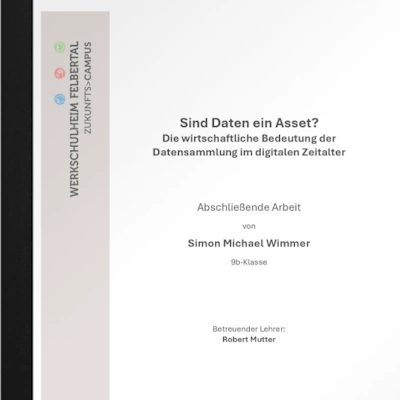
My final paper written at Werkschulheim Felbertal examines when and how collected data becomes an economic asset in the digital economy. Using examples from large tech platforms and data-driven business models, the work explores how personal and behavioral data is aggregated, monetized and traded, and which economic incentives drive ever-growing data collection.

The paper combines basic microeconomic concepts, business model analysis and an accessible overview of data protection and platform regulation to discuss the tension between commercial data use and individual rights. The work received the Dr. Hans Riegel-Fachpreis (1st prize in Informatics) from the Paris Lodron University of Salzburg, which recognized both its scientific quality and its societal relevance.

Prom Comittee

Management

I served as the chairman of the organizing committee for our high school prom and pre-graduation party with around 400 guests each and acted as a moderator as well as evening speaker. I was responsible for the overall concept, evening schedule, and the on-site execution of the event.

Likewise, I managed venue selection and contracting, obtained the official event permit, coordinated security and insurance providers, and oversaw ticketing, budgeting, and payments, including sponsor contributions and cost control. Dedicated subteams handled marketing, bar operations, and logistics, while I coordinated their work and served as the central point for decisions, risk management, and communication with school leadership and local authorities.

Stewart Platform

Software Hardware

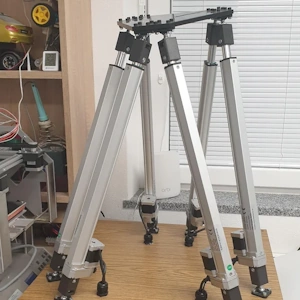
A Stewart platform that can move a top plate in all six degrees of freedom using six motorized linear actuators. The goal was to explore hexapod kinematics as a personal learning project and to build a small motion platform that mimics professional positioning systems.

I designed the mechanical structure in CAD, milled the base and housing parts, and 3D-printed custom joints and adapters to connect the actuators to the platform. On the electronics side, the system uses a Raspberry Pi with a self-designed interface PCB for stepper drivers, power distribution, and sensor connections.

The control software is realized in Python with a simple Flask-based web interface running directly on the Pi, allowing each axis to be moved from a browser and standard positions to be stored and recalled. Over time the project evolved into a documented build, including a detailed project report, a video series, and an Instructables guide that makes it reproducible for other makers.

Full Stack Web Development for a Kindergarten

Software

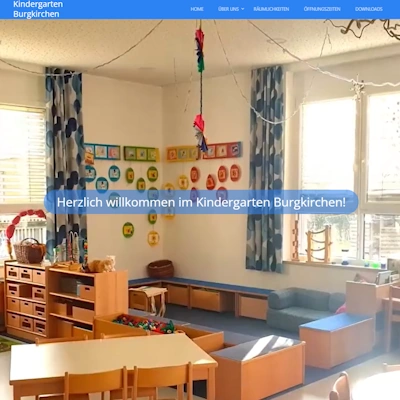
In a non-profit collaboration with the local Kindergarten Burgkirchen, I designed and developed a new website to improve the kindergarten's public presence and provide parents with easy access to key information, forms and news. The project covered the full stack from initial information architecture and layout planning to implementation with HTML, CSS/SCSS and JavaScript, plus deployment on a cloud hosting provider.

The project was run like a small client engagement: scope and deliverables were defined in a statement of work and requirements document, tasks were tracked in Asana, and I held regular review meetings with the kindergarten team to iterate on content and design. Beyond strengthening my front-end and basic cloud infrastructure skills, this project also trained stakeholder communication, expectation management and hands-on project management with a real community partner.

Business Concept - SimTech Innovations

Management

As part of the business administration course at Werkschulheim Felbertal, this mock-up project developed a complete business concept for “SimTech Innovations e.U.”, a fictional company focused on affordable, modular driving and flight simulators. The work covered market and competitor analysis, target group definition, site selection, supplier evaluation and basic financial planning, including funding structure and loan calculation.

Beyond the numbers, the project included branding and go-to-market ideas such as sales strategies, pricing models, customer personas and a style guide for the company's website, plus organizational design with divisional structures and HR concepts based on Maslow and Herzberg. This exercise connected technical interests like simulators with entrepreneurship and gave hands-on practice in thinking about products, customers and operations from a founder's perspective.

3D Printer CoreXY Upcycling

Software Hardware

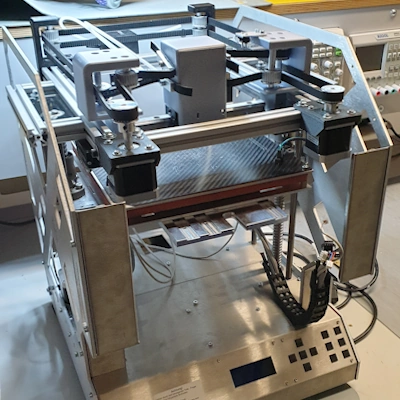
In this project an aging Renkforce RF1000 3D printer was rebuilt into a modern CoreXY machine with a new motion system, redesigned frame and a custom belt and guide layout. The mechanical conversion was planned in CAD, including new aluminum profiles, linear guides and 3D-printed mounts and idler blocks that re-use as many original parts as possible while significantly stiffening the gantry.

On the electronics side, the printer firmware was migrated to a current Marlin version, including configuration for the CoreXY kinematics, endstops and motion limits, plus tuning of step-per-millimeter, acceleration and jerk settings. This retrofit extended the useful life of the RF1000, improved print quality and speed, and offered a compact testbed for experimenting with custom hardware and firmware modifications.

Manager of Student Café

Management

As part of the 11th-grade “Zentrum” project at Werkschulheim Felbertal, I served as managing director of the student café for one school year, leading a team of 14 students and overseeing daily operations. Responsibilities included shift planning, supply management with wholesalers and local suppliers, pricing and budgeting, as well as organizing special events that contributed a significant share of annual revenue.

Together with the finance lead I tracked turnover, costs and profit distribution, while also coordinating small marketing campaigns and promotions to increase attendance. The café generated a five-figure revenue and a solid profit that was distributed transparently based on recorded shifts, turning the project into a practical exercise in small-business operations, leadership and team management.

DIY Smart Garden

Software Hardware

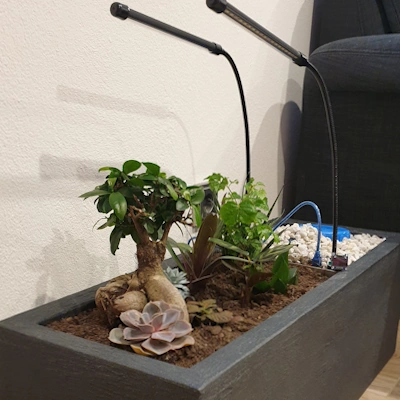
A DIY smart garden built as part of Hack Club's Winter Hardware Wonderland, designed to automatically water and monitor plants based on sensor data instead of fixed timers. The system uses an ESP8266 microcontroller with moisture, light and temperature sensors to control pumps and lighting, turning plant care into a closed-loop control problem rather than a simple on/off automation.

The project combines hardware design, PCB-free prototyping and enclosure work with embedded C++ for the microcontroller, a small web interface for configuration and data display, and a 10-day public build log documenting progress for the Hack Club grant. Beyond keeping plants alive, it served as a playground for integrating IoT concepts, feedback control and practical reliability considerations like fail-safe behavior and calibration of low-cost sensors.